What Is the Difference Between Tree Trimming and Pruning
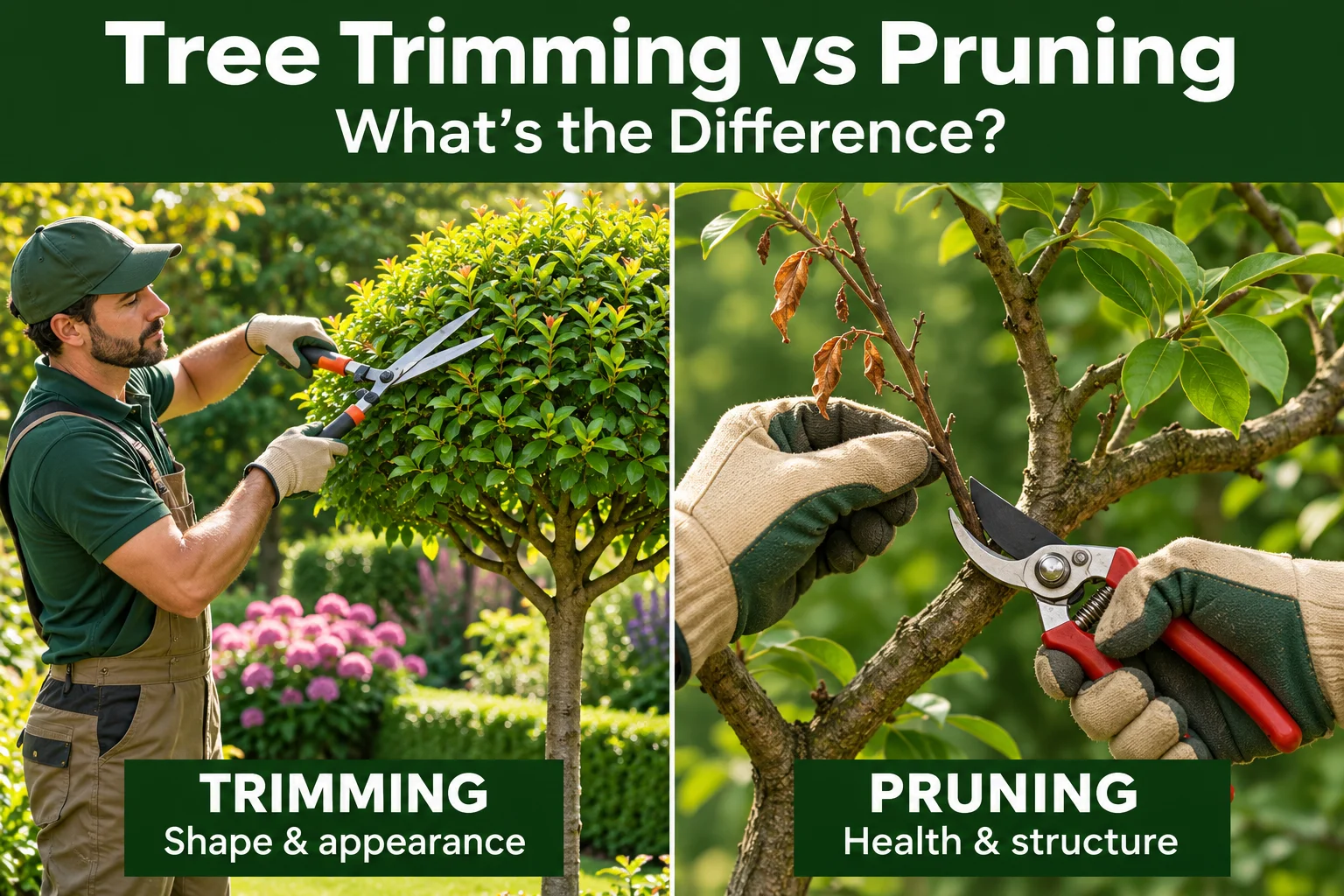
Tree trimming and Pruning are terms that are often used interchangeably; however, both services are similar, but their objectives vary slightly.
The main difference between the services lies in the reasons for which branches are removed, whereby tree trimming mainly aims to manage growth and maintain a tree's shape while avoiding obstruction of cars, paths, and buildings. In contrast, tree pruning presupposes the application of a scientific or selective approach toward the removal of diseased, broken, and dying branches of a tree so as to benefit from the better health of a tree and the protection of its structure.
Although tree trimming and tree pruning have different main functions, there can be some overlap between the two types of services whenever the condition of a tree requires one of these types of work. For instance, trimming is needed in order to prevent branches from blocking the way for cars, while Pruning can be used in the event of having any damaged branches or branches that can damage other ones on a tree.
Understanding the difference between tree trimming and Pruning can help you identify the care your trees may need. It can also help you avoid unnecessary cutting that could damage their growth or long-term health. In this guide, we'll explain how each service works, when to use it, the techniques involved and how to determine which approach is right for your trees.
What Is Tree Trimming?
Tree trimming refers to the removal of chosen branches or excess growth in a tree in order to maintain its desired shape, size and spread. This technique is typically used in the event that branches grow beyond the required area, block pathways or touch buildings.
The Main Purpose of Tree Trimming
The main objective of tree trimming is to manage growth while preserving the natural shape of a tree. Thanks to regular trimming, it is possible to improve the clearance and make the area more easily accessible. However, it is important to remember that trimming must be performed with care in order to ensure that enough foliage is kept.
When Do Trees Need Trimming?
Trees may require trimming in instances where branches obstruct pathways, interfere with structures nearby or grow beyond the limits of the available space. If the tree branches are dead, diseased, or damaged, Pruning may be required.
Common Examples of Tree Trimming
The most common examples of the tree trimming process include those which involve cutting the branches hanging over driveways, controlling growth near buildings and shaping ornamental trees.
What Is Tree Pruning?
The process of tree pruning means selectively removing branches for the purpose of enhancing the tree's health, structure and safety. Pruning differs from standard trimming, as it is targeted at branches that are diseased, dead, damaged or have an impact on tree growth.
The Main Purpose of Tree Pruning
The main aim of tree pruning is to sustain the tree's health and structural integrity. The process of Pruning can prevent certain diseases from spreading, strengthen certain ineffective branches and provide a solid structure for the tree.
Which Branches Should Be Pruned?
Branches which are weakly attached or growing in proximity to the structure of the tree may also need Pruning. This entirely depends on the species of tree, its condition and location. Dead or dangerous branches should be assessed by a certified arborist.
Common Examples of Tree Pruning
Common cases of Pruning include branches that are crossing each other, Pruning of young trees in order to develop appropriate structure, as well as pest control in mature trees through the removal of damaged and dead branches.
Tree Trimming vs. Pruning: Key Differences
While both tree trimming and Pruning involve branch removal, these processes differ in their aims, the branches chosen and the outcomes one hopes to achieve. As a result of knowing their differences, one can tell which method is suitable for the property.
Feature
Tree Trimming
Tree Pruning
Primary purpose
Manage shape, size and overgrowth
Support health, structure and safety
Branches removed
Selected overgrown or unwanted branches
Dead, damaged, diseased or poorly positioned branches
Main focus
Appearance and clearance
Tree health and structural development
Techniques
Cutting back selected growth to manage spread and shape
Selective cuts based on the tree's condition and growth
Maintenance frequency
Depends on growth rate and clearance needs
Depends on tree health, species and structural requirements
Effect on tree health
Can help manage growth when performed correctly
Can address specific health and structural problems when performed correctly
Purpose and Expected Results
The goal of tree trimming is to keep branches within certain boundaries and maintain its appearance. In contrast, Pruning solves various problems such as those connected with damaged branches or malformations in how the tree is growing.
Which Branches Are Removed?
The branches that are cut in tree trimming are the selected ones which have been growing out of shape or out of their designated area. Pruning, on the other hand, is concerned with branches which threaten the health of trees or their structure, like dead branches, sick branches, injured ones, or branches that overcross.
Techniques and Cutting Methods
When it comes to tree services, both techniques involve cuts that are appropriate to trees and tasks. In trimming, a cut will shorten a selected branch, whereas in the case of Pruning, the cuts will be made in a way that ensures the protection of the branch collar and that damage is minimal.
Frequency of Maintenance
Frequency of trimming is dependent on tree growth and the amount of clearance required. Pruning may occur once or more a year depending on the tree type, condition, and structure.
How Each Practice Affects Tree Health
Proper trimming helps keep branches from interfering with nearby buildings, while a good pruning practice helps eliminate damaged growth and provide proper structure for the tree. But too much cutting in both cases can weaken trees, reduce foliage, or expose the tree to new troubles.
When Should You Trim or Prune a Tree?
To determine whether a tree should be pruned or needs to be trimmed, consider the evolution of its growth process, its space and the conditions around it. A regular check of your tree will help you notice the above needs before they start being difficult to deal with.
Signs Your Tree Needs Trimming
There are roots under the tree which grow in spaces that are too small or in places that interfere with structures nearby. Typical signs of such requirements include:
· Branches encroaching on driveways, paths or terraces.
· Too much growth of a tree making it appear lopsided or overgrown.
· Branches growing in the direction of roofs, windows or fences.
· Branches that hang down low, interfering with the passage below the tree.
Signs Your Tree Needs Pruning
Pruning may be required if there are signs of growth damage or structural issues. Signs to look out for include dead limbs, damaged branches, infected areas or limbs that are crossing each other.
In addition, younger trees may require structural Pruning to promote proper branch growth. If you see deep cracks, split branches or large hanging branches, call an expert for an assessment instead of cutting the branches yourself.
When a Tree May Need Both Services
There are trees that need both trimming and Pruning depending on their maintenance requirements. For example, a mature tree may have branches that extend over a driveway and deadwood present on its branches. In this case, trimming would take care of the excess growth while Pruning would get rid of the dead or sick branches.
A professional specialized in restoring the tree's health will be able to determine which branches need to be treated and what method to use without cutting more than necessary.
What Is the Best Time to Trim or Prune Trees?
The ideal time to prune or trim a tree varies according to factors such as the type of tree, its growth pattern, physical condition and goals of trimming. Timing is important in maintaining proper tree growth and minimizing risks.
Seasonal Considerations for Tree Trimming
Tree trimming is performed depending on the needs of the tree, but excessive Pruning should not be done to reduce its size. It is essential to take the type of tree and the locality into consideration when planning tree trimming activities.
The Best Time to Prune Different Trees
Deciduous trees are usually pruned in late winter while they are dormant, which makes it easy to see the branches. However, flowering trees may need to be pruned at other times to avoid cutting the flowers, and different species have different pruning needs. Speak to an arborist to find out when to prune your tree.
When Damaged or Hazardous Branches Need Immediate Attention
Dead, broken branches may be dangerous and need to be dealt with straight away, no matter the time of year. Branches broken in a storm pose a danger to lives and property, while branches with breakages are at risk of falling. It is best to call a professional instead of trying to remove dangerous branches yourself.
Common Tree Trimming and Pruning Techniques
Tree trimming and Pruning utilize different techniques based on the tree condition, tree size and tree maintenance requirements. Understanding these techniques gives insight into how the specialists control the growth and keep the structure intact.
Crown Thinning and Canopy Management
Crown thinning is a technique in which branches are selectively removed from the crown of the tree to lower the density of the tree while keeping the shape of the crown as it is. Such work enables better penetration of light and better air circulation through the tree.
Crown Raising and Crown Reduction
Crown raising is associated with cutting off chosen branches in the lower part of the tree for the purpose of lifting the crown so that it is out of the way of pathways, driveways and other zones. In contrast, crown reduction is aimed at shortening the height and/or width of the trees by trimming needed branches until they reach properly placed branches. Both of these techniques require serious preparation in order to avoid any damage or excessive cutoffs.
Structural Pruning and Deadwood Removal
Structural Pruning makes it possible to ensure that branches are arranged in the most effective way, especially in younger trees. It sometimes requires deciding whether to prune competing shoots or weakly connected growths. Deadwood removal is about eliminating dead and broken branches that might fall on something or create a problem.
Why Correct Pruning Cuts Matter
Proper pruning cuts make it possible to protect the branch collar. This is the area that slightly extends from the trunk or another branch. Excessive Pruning makes it impossible for normal healing to take place. It's important that the right techniques of Pruning are used.
Can Incorrect Trimming or Pruning Damage a Tree?
Although trimming and Pruning assist in maintaining trees correctly, improper cutting could have a long-term damaging effect.
The Risks of Over-Pruning
Excessive Pruning means losing extra foliage and reducing the ability of the tree to produce its energy from photosynthesis. Moreover, it leaves branches that were previously shaded exposed to the harsh sun and subjects them to even more stress. This is why removing only the necessary shoots proves beneficial for maintaining the balance of the tree.
Why Tree Topping Can Cause Problems
Tree topping can be defined as the technique of cutting off large branches and upper trunks without applying the necessary reduction cuts. This results in enormous wounds and weak shoots. These can prove to be very dangerous when they grow, while the natural form and structure of the tree can change permanently.
How Improper Cuts Affect Tree Growth
Damaged tree collars and too-long stubs can interfere with the healing process of the tree. Big wounds take longer to heal and provide an opportunity for decay organisms to penetrate. If executed properly, cutting techniques can circumvent unnecessary damage.
Should You Trim or Prune a Tree Yourself?
Homeowners can easily perform a few minor tree care tasks as required. However, each action should be based on the type, condition and location of the tree. Knowing the limitations of DIY tree maintenance is crucial in order to avoid injuries and damage.
Which Tree Care Tasks Are Suitable for Homeowners?
Homeowners can cut a few low-hanging branches if they are able to do so safely from the ground using sharp pruning tools. Regular maintenance for young trees is possible with a thorough understanding of the applicable techniques. Nevertheless, a lot of growth should not be removed or cut without considering the ramifications for the tree.
When to Hire a Professional Arborist
In case of big trees, large dead tree limbs, storm damage, tree irregularities and also tree branches which are close to houses and electricity wires, tree specialists should be called in. Climbing or using a chainsaw involves a very high risk factor.
How Much Do Tree Trimming and Pruning Cost?
In the US for 2026, the typical prices for tree trimming services are around $460, with most homeowners expecting to pay anywhere between $270 and $1,800. The costs associated with tree trimming and Pruning will vary according to how big the tree is, as well as how much work needs to be carried out and how easy it is to gain access to the branches.
The final cost may vary due to the tree species, size, and accessibility. Tree pruning costs are also likely to vary depending on the overall condition of the tree and the kind of work needed.
Factors That Affect Tree Trimming and Pruning Costs
Some of the elements that determine the cost of tree trimming and Pruning are:
Size and height: The size and height of a tree play an important role in the cost of its maintenance. Taller trees, for instance, may require the use of special equipment in addition to more person-hours to maintain.
Condition of the tree: If a tree has damaged or infected branches, it is necessary to provide a more thorough assessment and more work, which means higher cost of services.
Accessibility: If a tree is located near the building or other objects, it would be relatively complicated and unsafe to maintain it. Additionally, working in restricted access circumstances requires more staffing and equipment.
Number of trees: During the first visit, service providers can give a different estimate depending on the number of trees that require maintenance.
Additional Costs to Consider
The cost you were quoted may only cover part of the work you need done. Depending on what services are provided, you may also want to account for:
Cleaning: If the contractor needs to remove the debris afterward, this may incur additional costs.
Tree examination: If you suspect your tree is suffering from a disease or insect infestation, you may need to pay for an arborist to perform an examination.
Equipment rental: In case the tree is large or in a hard-to-reach spot, hiring equipment like a cherry picker may be necessary.
Before signing the contract, ask the contractor if the quote covers labor, equipment, disposal and other possible fees.
Conclusion
The difference between Pruning and trimming trees depends upon the condition of your trees and what results you want from either tree care technique. Pruning is done when there is a need to solve problems related to a tree's shape or health condition, while trimming is performed to control a tree's growth and development. Thus, knowing the difference is the key to understanding how to take care of trees.
If you do not know which method to use, turn to a skilled arborist for professional help, who will assess the condition of your tree and suggest appropriate services.
Frequently Asked Questions
Trimming is one option for controlling overgrowth and keeping adequate distance between the tree and other structures. Nonetheless, whether trimming will enhance the tree's health or not depends on the trimming technique and the objectives of cutting. Although unnecessary branches should be removed, the operation may result in trees being influenced by trimming stress because each cut is meaningful.
Looking for a trusted professional?
Compare quotes from vetted tradespeople in your area — free and no obligation.
Get Free Quotes →