What Tools Do Electricians Use?
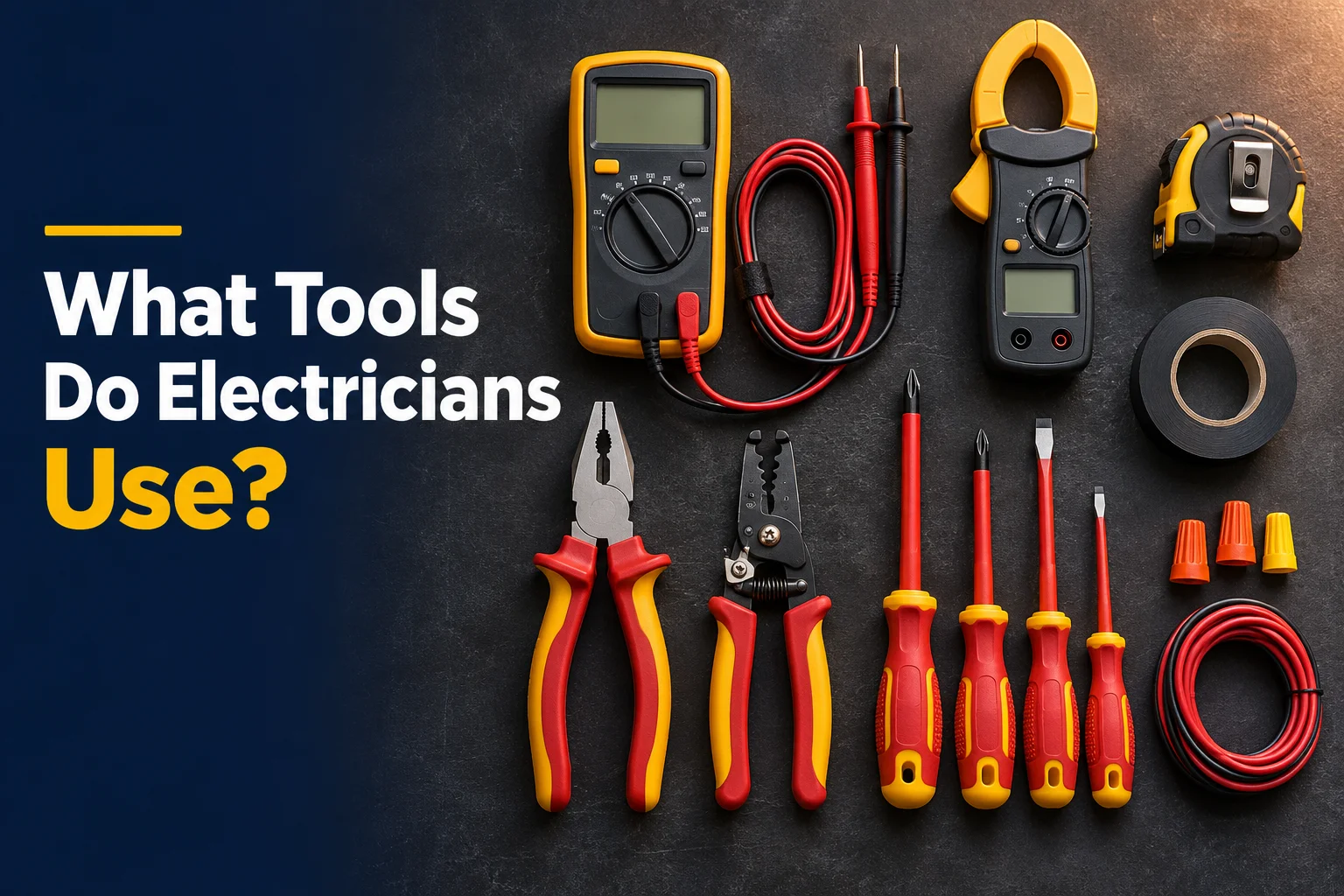
There are a number of tools that are used by electricians, and that includes insulated screwdrivers, wire strippers, pliers, a digital multimeter, a voltage tester, a cordless drill, fish tape and a conduit bender. Furthermore, in order to ensure that the installation is perfect, electricians use measuring tools, and in order to mitigate risks at the workplace, electricians should wear the necessary personal protective equipment.
The tools that an electrician will need to use depend on the type of project that he is working on. Irrespective of whether the electrician is working with residential wiring, commercial installation or an industrial electrical system, some tools will be used for simple tasks like connecting wires, and others make it possible to know where there are faults, measure voltage and measure how efficient the circuit is.
In this article, we have detailed the essential types of hand tools, testing devices, power tools, special tools and safety tools that are commonly used by an electrician.
1. Understanding an Electrician's Toolkit
An electrician's toolbox consists of various kinds of tools, such as those meant for different jobs in a given electrical task, which can be anything from wire preparation to repairs and installation of equipment. Every toolkit should include quite a number of types of tools, which consist of hand tools, testers, power tools, measuring instruments, and safety gear.
The tools also depend on the level of experience of the electrician as well as the kind of job involved. Thus, an apprentice electrician is expected to have just a few basic tools, say, a voltage tester and a few hand tools. In contrast, a professional electrician would have much more complicated equipment for diagnosis, with advanced tools that facilitate highly complicated tasks.
2. Essential Hand Tools for Everyday Electrical Work
Hand tools are among the most utilized tools in an electrician's toolbox because they are commonly used in daily wiring, installation, and repair work. Electricians use screws, pliers, and cutting tools to work with wires efficiently.
Insulated Screwdrivers
Insulated screwdrivers help in unscrewing or screwing screws in electronic devices such as switchboards, sockets, and circuit breakers. They have an insulated handle and shaft that prevent electric shock while working with electronic devices. Electricians use both flathead and Phillips insulated screwdrivers depending on the screw type.
Lineman's Pliers
Lineman's pliers are strong hand tools used for gripping, twisting, bending, and cutting wires. Their effective jaws provide a high grip on wires when joining wires or locking electrical connections. Most of these devices also come with cutting edges at the pivot point to allow electricians to cut thicker wires while making repairs or installing them.
Needle-Nose Pliers
Needle-nosed pliers come with a pair of long, narrow jaws that enable electricians to access the wire and parts in cramped or small areas. They are especially useful for bending wire ends, clamping small parts, and setting connections inside electrical boxes. Their body design offers more control when working in a place where bigger pliers cannot be used.
Wire Strippers
Wire strippers are designed to strip the insulation of wires without causing damage to the metal wire. Electricians use wire strippers when they need to prepare wires before connecting them to switches, outlets, and other electronic parts. Mostly, wire strippers will have holes of various sizes suitable for different wire gauges.
Diagonal Cutting Pliers
Also known as side cutters, diagonal cutting pliers are meant to cut wires, thin cables, and even plastic ties. Because of their shape, they enable electricians to carry out cutting jobs without hassle in areas where other pliers may not fit.
Cable Cutters
Cable cutters are tools that can be employed to cut through thick electrical cables. Their specialized blades have been designed such that they can provide a sufficient amount of leverage to make neat cuts, but at the same time without damaging or destroying the cables too much. Electricians use the tool to prepare the cables before installation, during changes or during the connection.
Why Are These Hand Tools Important?
All hand tools have different purposes, but most often they work as a team to carry out electrical work and installations. For instance, cable cutters can be used to shorten a specific cable, then wire strippers can be used to remove its insulation, and finally, lineman's pliers are used to hold the wires. Thus, it is very important to have a correct set of hand tools.
3. Electrical Testing and Troubleshooting Equipment
An electrician works with electrical testing equipment to check the condition of the circuits beforehand. The tools are critical in knowing if the circuit operates well, if they are correctly connected and if the tools are working properly.
Digital Multimeter
A digital multimeter works for measuring voltage, current and resistance. It allows the electrician to find out about the power supply state, whether the circuit is working, and if the elements are working properly. With most digital multimeters, there is a function that provides the options to measure both AC and DC.
Voltage Tester
A voltage tester helps in ascertaining how much voltage is in a given wire. There are different types of electric testers that show whether the current is present in the circuit.
Clamp Meter
Using a clamp meter eliminates the need for electricians to cut into wires to measure the electrical current. This device opens willingly around one wire to measure how much current passes through it. Electricians tend to utilize this device for monitoring loads, detecting overloads, and researching electrical devices.
Circuit Tester
An electrician circuit tester is a practical tool used by electricians to figure out if an electrical circuit or connection is functioning normally. Commonly available outlet testers also give information on wiring issues, including the wrong order of hot and neutral wires and missing ground wires. Electricians find these tools useful when checking the outlets after installation and in troubleshooting.
Insulation Resistance Tester
An insulation resistance tester is a device that provides information regarding the insulation of electrical conductors. Using the insulation resistance tester helps one learn the degree of insulation deterioration, presence of leakage paths, and faults in connection and installation of the system.
Non-Contact Voltage Tester
A Non-Contact Voltage Tester identifies the existence of AC voltage without touching the live conductor. Electricians use it to carry out the initial voltage assessment of sockets, switches, wire cables, and electrical devices. Most specified models of Non-Contact Voltage Testers show either visual or audible indications of the electric field but only signal the presence of voltage without proving the circuit is safe to touch.
How to Select the Proper Test Equipment
Multimeters measure multiple electrical parameters, while clamp meters perform electric current measurements only. Voltage testers and Non-Contact Voltage Detectors detect voltage, whereas insulation testers measure the condition of the insulation. Electricians make their choice of a device based on the type of fault or measurement they would like to perform. Test equipment has to comply with the requirements of the instructions provided by its manufacturer.
4. Power Tools Used in Electrical Installations
Electricians employ power tools to perform installations that involve drilling, cutting, fastening, and other operations requiring openings in different materials. Unlike hand tools, these tools utilize electric and battery-powered motors, easing manual work and hastening processes.
Cordless drills
Cordless drills have a widespread application in drilling holes in wood, metal, and many other materials during electrical installations. With the use of cordless tools, electricians perform tasks geared at creating routes for wires, setting boxes, and fixing brackets. The rechargeable battery supply allows work to be performed in places where there is no power outlet nearby.
Impact driver
Impact drivers are created to drive screws and fastening devices into various hard materials at much higher torque than conventional drills. They are put to use by electricians in fixing electrical boxes, wire supports, brackets, and other types of mountings.
Rotary Hammer
The rotary hammer is a very powerful device that can bore holes into bricks, stones, and other similar materials. It has the functionality of both a rotating and a hammering tool. The construction and electrical workers make use of the rotary hammer in installations that involve solid surfaces.
Reciprocating Saw
The reciprocating saw works by moving the saw blade back and forth so that different materials can be cut. The electricians use it to cut holes in the walls, shape the materials, and cut parts of the concrete surface to get access to the cables. The type of blade selected depends on the material being cut.
Hole Saw
The hole saw is a drilling attachment that can be joined to a drill in order to drill a larger hole. Electricians use it to create holes in any surface for the purpose of placing lights, junction boxes, etc. Different kinds of attachments can be used for drilling holes of various sizes.
5. Tools for Pulling, Bending, and Routing Wires
Electrical wiring passes through different structures of houses and is facilitated through the use of specific equipment by Soldiersville TV installation service to help them do their job correctly. The tools that they use help them pass wires through narrow walls and locations, transport cables to longer distances, and curve conduits.
Fish Tape
Fish tape is a thin, flexible tape made of metal or fiberglass that is used to help electricians pass wires through some areas. The main idea behind its usage is that people feed it to where they want to connect wires. Then it is pulled back together with wires attached to the tape.
Cable Puller
A cable puller is a tool used to help electricians pull wires through long routes or passages. By using the cable puller, workers can control the force of pulling.
Conduit Bender
A conduit bender is a tool that bends electrical conduits into varied specific angles and shapes without damaging them. Electricians use this tool to make neat turns at corners or around obstacles whenever laying wires. Depending on the size, thickness, and bending requirements of the conduit, there can be manual or hydraulic varieties.
Cable Lubricant Applicator
A cable lubricant applicator is a device for applying an approved pulling lubricant over electric cables or within conduits when they are being installed. Use of a good lubricant lowers friction between the cable and the walls of the conduit, thus facilitating wire pulling through long and narrow channels. Electricians use this device to make sure that there is less pulling resistance and the cable insulation doesn't get damaged.
Cable Crimping Tool
A cable crimping tool is used for connecting different connectors, terminals, and lugs to the electric wires. Electricians use tools like cable crimpers and connectors depending on the size of the wire. Proper crimping will give the connection good mechanical and electrical properties suitable for use in control panels, distribution boards, etc.
6. Measuring and Marking Equipment
When it comes to installation of electrical elements, distance matters a lot. Electricians take measurements and markings to determine distances, check alignment and know which sites to install electrical equipment in before drilling or cutting.
Tape Measure
One of the tools used to measure distances, cable runs and place electrical equipment is a tape measure. Electricians use it while marking outlet, switch, light fixture and electrical box positions, as it is portable and easy to handle.
Laser Level
A laser level is used to draw the proper reference line on the surface, allowing electricians to position electrical equipment accurately. Thus, it is helpful in aligning multiple outlets and switches, light fixtures and PVCs on ceilings or walls, thus avoiding spacing and alignment faults.
Spirit Level
A spirit level consists of a liquid-filled vial and an air bubble and is used to determine whether a certain surface or object is horizontal or vertical. Electricians use it for installing electrical boxes, mounts, panels, and other fixtures, in order to avoid improperly carried out installations.
Stud Finder
A stud finder detects wooden or metal framing behind walls, so electricians can find proper points for installation, avoiding existing structural elements. Some specialized models are capable of detecting live electrical wires as well. Electricians use it before drilling or cutting walls to avoid any damage to the hidden wiring.
Marking Pencil
A marking pencil is meant to create reference points, lines, and measurements. It is widely used by electricians for marking installation locations such as places for drilling holes, directing wires, and putting electrical boxes in the right place.
7. Personal Protective Equipment for Electricians
Electricians run the risk of electric shock and other dangers such as arc flashes, flying debris, and falling objects while performing electrical work. To minimize these dangers, they wear personal protective equipment (PPE) appropriate for the job and the surroundings.
Insulating gloves
The purpose of insulating gloves is the prevention of electrical shock to electricians while they perform their work on energized equipment. The insulating gloves are available in different classes of voltage and must meet all safety requirements. The use of leather protectors is also standard since they provide protection against physical damage to rubber insulating gloves.
Safety goggles
Safety goggles are important for preventing any harm to the eyes of electricians while working since they protect them from dust, metal pieces and debris when drilling, cutting, or installing some equipment.
Face Shields
Face shields are used for additional protection against flying particles, sparks, and arc-flash risk. Electricians may wear face shields when working with tools that pose electrical arc and hot material hazards. For an arc flash face shield to be effective, it needs to have the correct rating and be worn with the proper protective gear.
Hard Hats
Hard hats give head protection to electricians from head injuries caused by falling objects, blows, and overhead risks. They are especially useful in construction sites and environments in which objects may move above workers.
Safety Boots
Safety boots protect electricians' feet from heavy objects, sharp materials, and hazards. Electricians have to select safety boots that fit their workplace safety requirements depending on the job type, as they may need to have protective toe caps, puncture-resistant boots, or electrocution prevention properties depending on the job type.
Arc-Rated Clothing
Arc-rated garments are designed to protect people from burn injuries due to the strong heat and energy associated with an electrical arc flash. The clothes are made from flame-resistant material, and the selection is based on the risk of the arc flash. Engineers handling heavy equipment where there is an arc flash hazard would be required to wear arc-rated shirts, trousers, and other protective clothing.
8. Specialized Equipment for Advanced Electrical Work
Some forms of electrical work require more complex testing devices and instruments because it can be difficult to troubleshoot complicated malfunctions or assess larger electrical systems. Special equipment is able to accurately detect electrical features such as temperature, circuit routes, signal behavior, and connection solutions.
Thermal Imaging Camera
The thermal imaging camera detects temperature variations in electrical parts and delivers a thermal picture. Electricians can apply it for the purposes of estimating heating connections, overheating circuitry, and hot spots on boards without touching the installations. Such temperature contrasts make it possible to find problems before anything goes wrong.
Circuit Tracer
A circuit tracer is used by an electrician to discover circuit breakers that are connected to an outlet (an electrical device). The device transmits the signal through the wiring. It can also be helpful for tracing circuitry in distribution boards.
Oscilloscope
The oscilloscope is an instrument used for observing electrical signals as waveforms. The oscilloscope allows electricians and electrical engineers to investigate how voltage varies over time. It also provides an opportunity to analyze aspects like the frequency of the signal and incidental disturbance in the circuit.
Earth Ground Tester
An electrical ground tester is a device used for measuring the degree of resistance in the electrical grounding system and whether these resistors act as a path for faulty current. Electricians may use this equipment while inspecting electrodes to gain information about their condition or whether they are working properly.
Phase Rotation Meter
A phase rotation meter is used to identify the order of phases in the three-phase system. Electricians use this system whenever they connect or inspect three-phase motors in order to check whether the sequence is correct. Otherwise, in the case of the absence of the right sequence, a motor can perform operations in the reverse order.
9. How to Build an Electrician's Toolkit
The first step in establishing an electrician's toolkit is to determine which type of electrical activity you intend to undertake in the future, as far as the tools needed are concerned. Electricians do not have to obtain every single tool they find in stores but should focus on obtaining the most vital pieces of equipment, along with gradually purchasing the rest of them only when the nature of work requires such purchases.
Basic Tools for Beginner Electricians
At the very beginning, novice electricians can start with a set of basic hand tools that contain insulated screwdrivers, wire strippers, pliers, cutters, and measuring instruments. These instruments are essential in the learning process to perform common installation and maintenance activities under careful supervision.
Tools for Skilled Electricians
Unlike apprentice electricians, professionals require more equipment for various installation, repair, and troubleshooting operations since their toolkits should be larger. Thus, professional electricians can have digital multimeters, clamp meters, power tools, cable pullers, and diagnostic equipment in their toolkit.
Tools for Residential and Commercial Projects
Usually, the different types of basic tools used by residential electricians include wiring instruments, voltage measurement devices, drills, and measurement devices. However, depending on the size of the electrical installations and complications involved in the task, commercial electricians might also need to use cable pullers, conduit benders, thermal imaging cameras, and many other advanced devices.
10. How to Keep Electrical Tools in Good Working Condition
Maintaining tools routinely makes it easy and useful for electrical workers to use them on a daily basis. Dirt, humidity, damaged insulation and worn parts influence the performance of tools and increase the potential hazard. Adhering to some simple practices will allow you to prolong the working life of electric devices and avoid frequent replacements.
· Cleaning tools after use: Wipe tools with appropriate detergents to clean dust, dirt, grease, and other contaminations.
· Inspections: Look over handles, insulation, wires, blades, and movable components for any signs of damage prior to use.
· Storage: Put tools in a dry and well-organized toolbox or in a storage cabinet.
· Maintaining testing equipment: Check leads, batteries, and instruments regularly and perform checks as specified by the manufacturers and regulations.
· Replacing damaged tools: Stop using defective devices and repair or replace them before employing them further.
Conclusion
Electricians must have different kinds of equipment to install, fix, test and maintain power systems. Basic tools, from a hammer to a powerful tool, in addition to advanced instruments and protective gear, each one of them helps in performing the electrical work accurately and safely. Using specific high-quality equipment helps electricians be effective in their work and cope with different tasks successfully.
Looking for a trusted professional?
Compare quotes from vetted tradespeople in your area — free and no obligation.
Get Free Quotes →